Dog walking, dog training

Why we use and recommend positive reinforcement and reward-based training.

We use positive reinforcement and reward – based training because it strengthens the bond between you and your dog. All animals, including dogs and humans, learn better without the threat of punishment.

Punishment or aversives are anything a dog will work to avoid. This includes pinch, choke, shock, or ecollars, loud noises, spraying with water, even just yelling can be considered aversive.

Punishment may stop a behavior in the moment, but it doesn’t teach the dog what you want him to do. Punishment weakens your bond with your dog and can also cause fear, anxiety, and stress. Because dogs learn by association, it can also cause your dog to associate whatever he was focused on at the moment, with the pain of the aversive. This can cause him to form a negative association with whatever he was focused on. It could be a dog, person, or a child. The next time he encounters it, he will remember the pain and fear and could become reactive towards it.

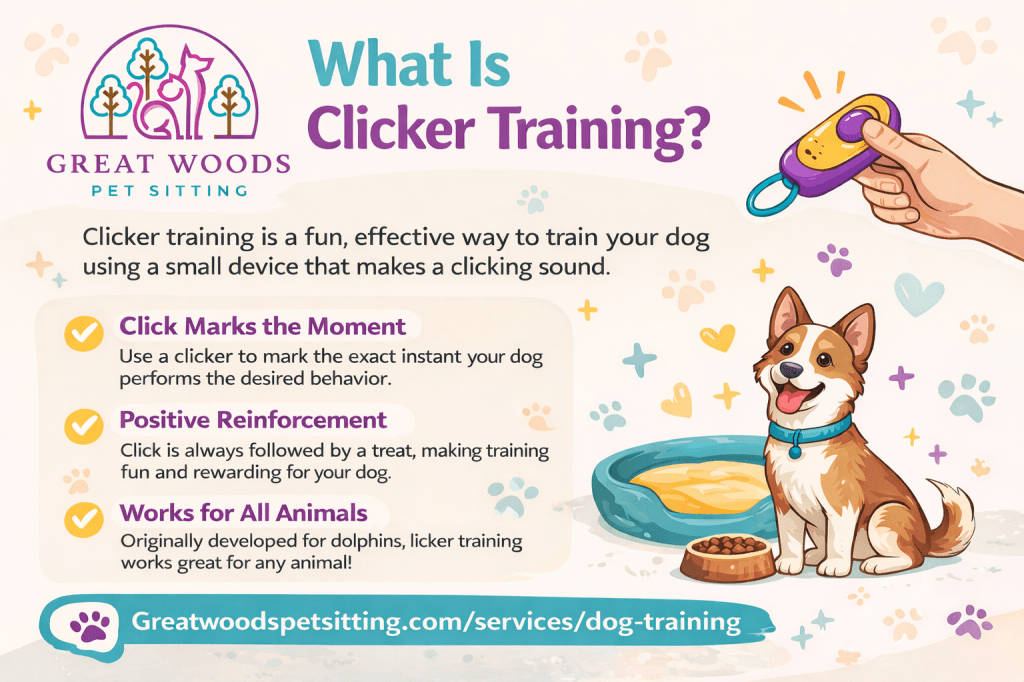
Positive reinforcement includes anything your dog will work to earn including Dog Training Treats, toys, praise, or playtime.

Instead of waiting until he does something you dislike, train him by rewarding him for doing what you want instead. Until he is reliably trained, you should prevent your dog from performing the unwanted behaviors and keep him safe with management. Management includes things like crating or confining your dog to a room or a section of the house, keeping him on a leash or long line, or blocking off areas you don’t want him to have access to.

If your dog chews things in your house, make sure everything he might be tempted to chew is picked up and out of reach. Give him plenty of dog – safe options like Kongs and chew toys to satisfy his need to chew.

If your dog pulls on the leash, reward him frequently for walking by your side. We recommend front-clip, Y-shaped Harnesses for pullers, combined with frequent reinforcement. Pulling is self rewarding, it gets him to all the good smells. Let him sniff, but don’t let him pull.

If your dog jumps, keep him behind a gate to prevent him jumping on visitors. You can teach him to go to his bed or place or have him fetch a toy to give him something to do that isn’t jumping.

The more often you reward a behavior, the more it will be repeated. You can build a reward history so your dog is happy to walk by your side. Instead of jumping on visitors, he will happily go to his place or fetch his toy.

If you reward him frequently and generously for coming every time he is called, never punish him for not coming or call him for anything unpleasant, he will learn that coming to you means only good things, and is more likely to come when called. You are competing with things in the environment, so unless you can completely control the environment, I would recommend not letting your dog off leash unless you are 100% certain he will come when called.

Your dog will be happier and less stressed if you use positive reinforcement instead of aversives to train him.

If you need help training your dog, Contact Us today !

AVSAB-Humane-Dog-Training-Position-Statement-2021.pdf

https://hsmo.org/AVSAB-The-Problems-Using-Punishment.pdf

How to train your dog to come every time – 12-Rules-for-Rocket-Recall-with-Book-0522.pdf

Uncategorized

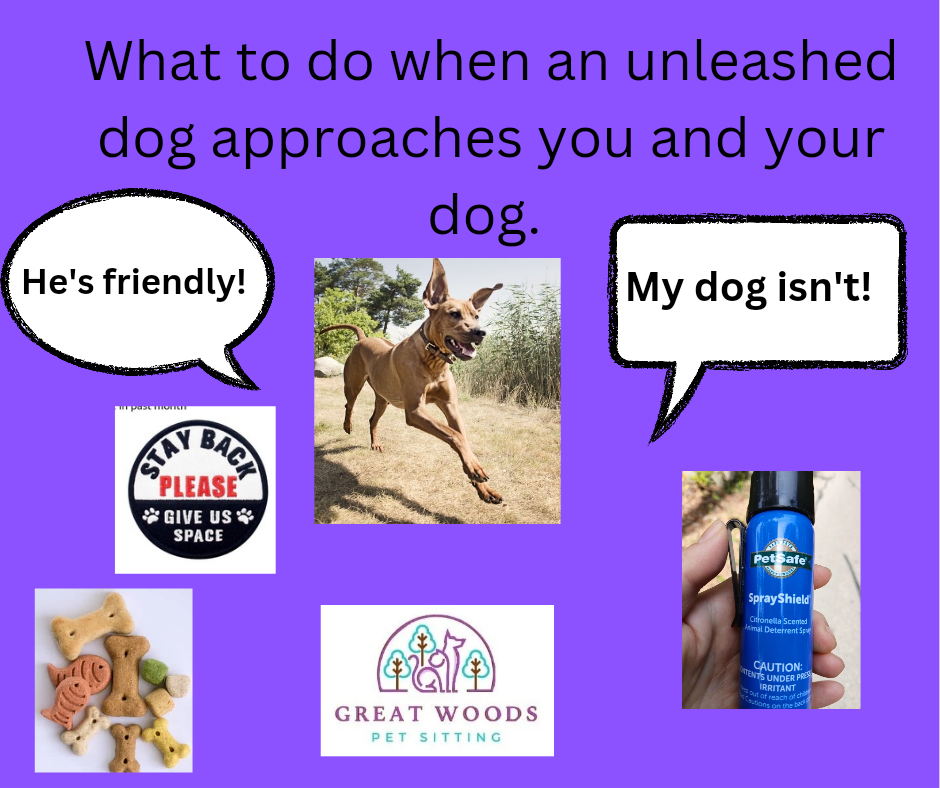
What to do when an unleashed dog approaches you and your dog

It can be scary when an unleashed dog approaches you while you are walking your dog. I have been a professional dog walker for many years. I have had countless dogs come up to me and the dog I am walking. If you walk your dog in public, sooner or later you will encounter an unleashed dog coming up to you. Here are some tips to help avoid and handle these scary and dangerous encounters, and how to keep you and your dog safe.

  • Know your route and be aware of your surroundings. It is always better to avoid an encounter then try to break one up.
  • Avoid areas where there are known loose dogs, dogs with electronic fences, or areas where owners regularly let their dogs off leash like wooded areas or fields.
  • If you know or suspect your dog may become aggressive, train him to wear a muzzle, and muzzle him in public. In Massachusetts, you can be held liable if your dog injures another dog, even if the other dog was loose, and yours was on leash. ( it happened to a client of mine)
  • If a dog approaches you, try to stay calm. Your dog can sense your fear, which makes the encounter more scary for your dog.
  • If you see a loose dog, have your dog do a u-turn, and quickly walk away. Train this ahead of time, so your dog knows what to do and you can react quickly and instinctively.
  • If a dog approaches you and the owner is in sight, yell, “Get your dog, my dog bites, my dog isn’t friendly, my dog is sick, my dog is contagious, I will spray your dog.” or something to get the owner’s attention and get them to take action and get their dog.
  • Consider getting a leash wrap or patch to warn owners to keep their dogs away.
  • Hold your hand up like a stop sign, lean towards the dog, tell the dog to sit or go home.
  • Throw treats over the dog’s head while you and your dog quickly walk away.
  • Carry something to deter loose dogs. My favorite product to carry is Spray Shield Citronella Animal Deterrent , a citronella – based spray that won’t hurt the dog. I spray it in front of the dog and it usually deters them from approaching.
  • Other options are Pet Corrector Spray an umbrella, retractable baton or stick, or an air horn. Be aware that an air horn will scare your dog as well. You should desensitize your dog to the umbrella before using it. Pepper spray should only be used as a last resort since it could hurt the other dog, blow back on you and your dog, and make the other dog more aggressive. It could also be illegal, depending on where you live.
  • Know how to break up a fight. Do not put your hands near the dogs mouths. If you are alone, grab the back leg of the more aggressive dog, and push in. If you have help, both people should grab the back leg of each of the dogs.
  • If you spray, hit or kick the dog, be prepared for the owner to get mad and retaliate.
  • Record the incident, if possible, and report it to the ACO or police. Having proof and a record of the incident protects you in case the other owner tries to blame you, or if you need to seek damages from the other owner. It also creates a history in case the dog gets loose again.
  • Take your dog to the vet if your dog may be injured. You may not notice small puncture holes or soft tissue injuries.
  • Avoid that area and possibly all walks for at least a few days. Your dog may seem fine, but it was still a traumatic event. Don’t make your dog relive it by going right back to where it happened.

Encounters with loose dogs are scary and unpredictable. Having a plan, and being prepared can help you feel safer and help prevent you and your dog from getting hurt.