

Dog walking, dog training

Easing Your Dog Into Back-to-School Routines

The start of a new school year brings a big change in routine for the whole family—including the dog.
After spending the summer with children at home, your dog may suddenly find the house much quieter. Morning schedules become busier, familiar playmates disappear for several hours, and walks or meals may happen at different times. Even dogs who normally handle time alone well can need a little help adjusting.

How Your Dog May React

Dogs thrive on consistency. When the family’s schedule changes, you might notice:
Following family members around more than usual
Waiting by the door or watching out the window
Barking, whining, or pacing
Chewing or getting into things
Changes in appetite or sleep
Extra excitement when the children return home
Some dogs simply need a few days to learn the new routine. Others—especially puppies, seniors, recently adopted dogs, and dogs who are sensitive to change—may have a harder time.

Start the School Routine Early

If possible, begin adjusting your dog’s schedule before the first day of school. Gradually move breakfast, walks, and bathroom breaks to the times they will happen during the school year.

You can also practice short periods of separation while everyone is still home. Give your dog something enjoyable to do, leave the room or house briefly, and return calmly. This helps being alone feel like a normal part of the day.

Give Your Dog Something to Do

A little enrichment can make a quiet morning more enjoyable. Try leaving your dog with:

  • A stuffed food toy
  • A lick mat
  • A safe chew
  • A snuffle mat
  • A simple treat-search game

Choose items that are safe for your individual dog to use without supervision. Rotating activities can help keep them interesting.

A walk before everyone leaves can also help. It provides exercise, sniffing, and an opportunity to go to the bathroom before the household becomes quiet.

Keep Departures and Homecomings Calm

Long, emotional goodbyes can make departures feel like a major event. Instead, keep the morning routine relaxed and predictable.

When the children return home, encourage them to greet the dog calmly. An overly excited reunion can be overwhelming, especially if the dog is jumping, mouthing, or racing around. Once everyone has settled, the children and dog can enjoy some playtime or a walk together.

Consider a Midday Dog Walk

For many dogs, a midday visit provides the perfect break in a long school or workday. A walk gives your dog a bathroom break, exercise, companionship, and a chance to sniff and explore.

Puppies and senior dogs may especially benefit because they often cannot comfortably wait as long between bathroom breaks. A dependable midday routine can also give the family peace of mind during a busy day.

Great Woods Pet Sitting provides reliable, one-household-at-a-time dog walks in Norton and Mansfield. Every visit includes attentive, positive care and a GPS-tracked report card, so you can see how your dog’s walk went.

When Your Dog Needs More Help

If your dog is panicking when left alone, trying to escape, damaging doors or windows, drooling heavily, refusing food, or unable to settle, speak with your veterinarian or a qualified positive-reinforcement behavior professional. These behaviors may indicate separation-related distress rather than boredom or a simple adjustment period.

Most dogs can adapt to the back-to-school transition with patience, consistency, and a routine that meets their needs. A little preparation can make the change easier—and help your dog feel secure even when their favorite kids are in class.
Dog walking, dog training

🐾 Blog Post: What Is Clicker Training — And Why It Works So Well

If you’ve ever wondered what clicker training is and why so many trainers love it, this post will break it down in simple, helpful terms.
🟡 What Is Clicker Training?
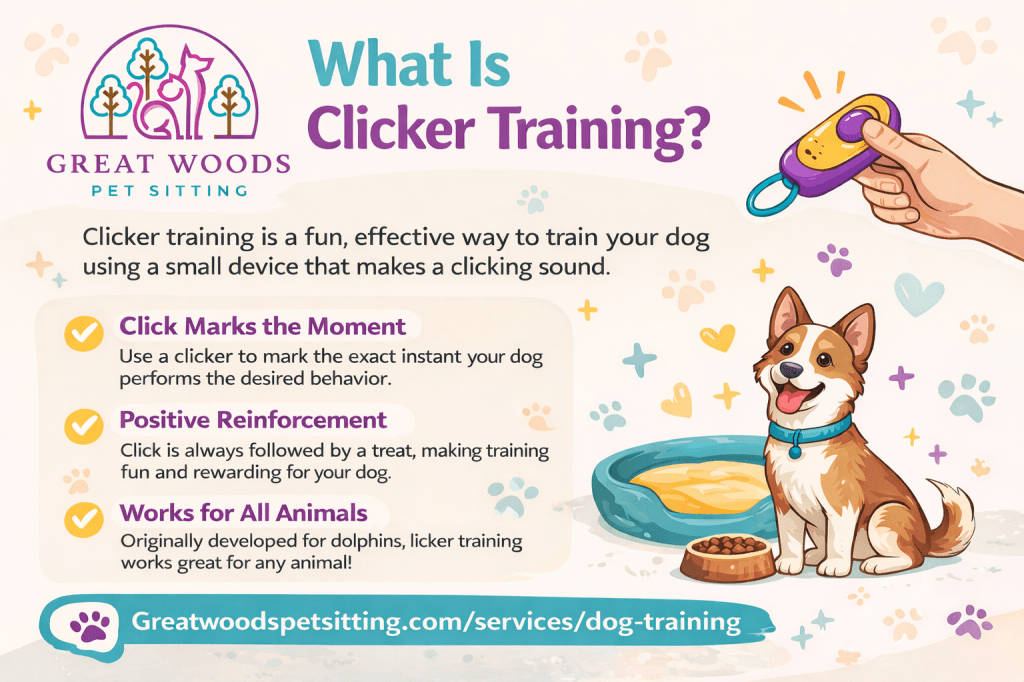
Clicker training is a form of positive reinforcement training that uses a small device called a clicker to mark desirable behaviors. The clicker makes a consistent, distinct sound that tells your dog, “Yes! That’s exactly what I want!” — and it’s immediately followed by a reward.

🟢 How It Works
A clicker is what we call a conditioned reinforcer. That means:
It doesn’t mean anything to a dog at first.
You pair the click with something your dog loves — like a tasty treat, praise, or play.
After a few repetitions your dog learns: Click = Treat.
Because what gets rewarded gets repeated, your dog will try to offer the behavior that earns the click and the reward.

📍 Why Use a Clicker?
A clicker has a few big advantages:
✅ Precision – The click marks the exact instant the behavior happens.
✅ Consistency – The sound is always the same, no matter who’s clicking.
✅ Clarity – Dogs quickly learn to associate the behavior with the reward.
This makes learning clear, fast, and fun for your dog.
⚠️ Important: A click should always be followed by a reward — otherwise the sound loses value.

🎯 Three Ways to Use the Clicker
📌 Luring
You guide your dog into a behavior using a treat.
Example: Hold a treat above your dog’s head so they sit. Click the moment their butt touches the ground — then reward.
📌 Shaping
You reward small steps toward a bigger behavior.
Example: Want your dog to go to a bed?
Click for looking at the bed
Click for moving toward it
Click for touching it
Click for lying on it
Then reward each step!
📌 Capturing
You mark a behavior your dog does on their own.
Example: If your dog sits without being asked, click and reward to encourage them to do it more often.

📚 A Little History
Clicker training became popular in dog training after Karen Pryor, a marine mammal trainer, wrote the influential book Don’t Shoot the Dog. Pryor demonstrated how this method works across species because all animals — including dogs — learn the same way through reinforcement.
Because of this, clicker training isn’t just for dogs — it’s used for cats, horses, birds, and even in some human teaching techniques!
There’s also a branch of training for people using the same principles called TagTeach.
🛠 Want to Learn More?
The Karen Pryor Academy has excellent courses, books, clickers, and treat pouches to get started.
If you’d like help clicker training your dog, I offer personalized guidance tailored to your dog’s needs.
👉 Check out my dog training services here: greatwoodspetsitting.com/services/dog-training/

Dog walking, dog training

Why we use and recommend positive reinforcement and reward-based training.

We use positive reinforcement and reward – based training because it strengthens the bond between you and your dog. All animals, including dogs and humans, learn better without the threat of punishment.

Punishment or aversives are anything a dog will work to avoid. This includes pinch, choke, shock, or ecollars, loud noises, spraying with water, even just yelling can be considered aversive.

Punishment may stop a behavior in the moment, but it doesn’t teach the dog what you want him to do. Punishment weakens your bond with your dog and can also cause fear, anxiety, and stress. Because dogs learn by association, it can also cause your dog to associate whatever he was focused on at the moment, with the pain of the aversive. This can cause him to form a negative association with whatever he was focused on. It could be a dog, person, or a child. The next time he encounters it, he will remember the pain and fear and could become reactive towards it.

Positive reinforcement includes anything your dog will work to earn including Dog Training Treats, toys, praise, or playtime.

Instead of waiting until he does something you dislike, train him by rewarding him for doing what you want instead. Until he is reliably trained, you should prevent your dog from performing the unwanted behaviors and keep him safe with management. Management includes things like crating or confining your dog to a room or a section of the house, keeping him on a leash or long line, or blocking off areas you don’t want him to have access to.

If your dog chews things in your house, make sure everything he might be tempted to chew is picked up and out of reach. Give him plenty of dog – safe options like Kongs and chew toys to satisfy his need to chew.

If your dog pulls on the leash, reward him frequently for walking by your side. We recommend front-clip, Y-shaped Harnesses for pullers, combined with frequent reinforcement. Pulling is self rewarding, it gets him to all the good smells. Let him sniff, but don’t let him pull.

If your dog jumps, keep him behind a gate to prevent him jumping on visitors. You can teach him to go to his bed or place or have him fetch a toy to give him something to do that isn’t jumping.

The more often you reward a behavior, the more it will be repeated. You can build a reward history so your dog is happy to walk by your side. Instead of jumping on visitors, he will happily go to his place or fetch his toy.

If you reward him frequently and generously for coming every time he is called, never punish him for not coming or call him for anything unpleasant, he will learn that coming to you means only good things, and is more likely to come when called. You are competing with things in the environment, so unless you can completely control the environment, I would recommend not letting your dog off leash unless you are 100% certain he will come when called.

Your dog will be happier and less stressed if you use positive reinforcement instead of aversives to train him.

If you need help training your dog, Contact Us today !

AVSAB-Humane-Dog-Training-Position-Statement-2021.pdf

https://hsmo.org/AVSAB-The-Problems-Using-Punishment.pdf

How to train your dog to come every time – 12-Rules-for-Rocket-Recall-with-Book-0522.pdf